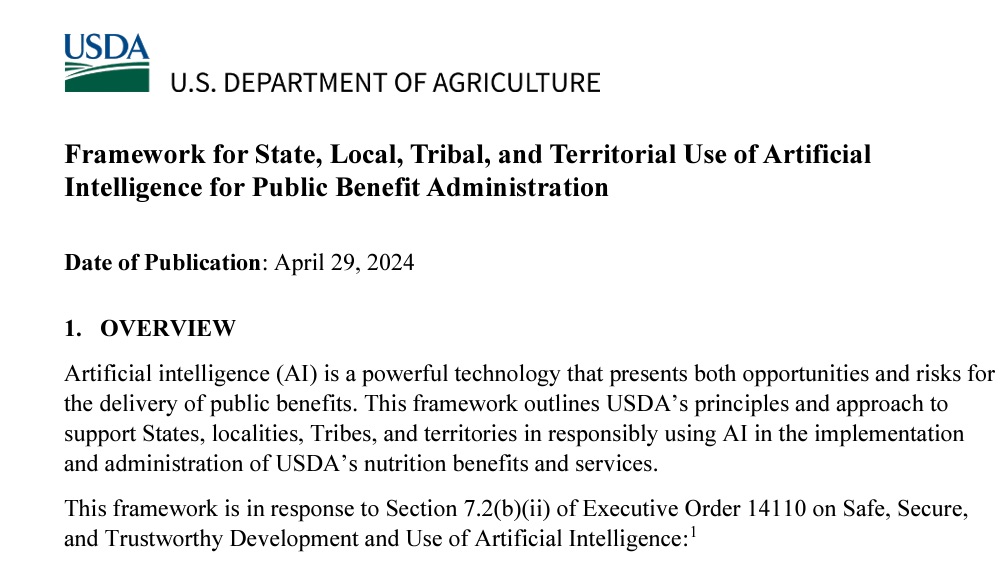
This framework outlines USDA’s principles and approach to support States, localities, Tribes, and territories in responsibly using AI in the implementation and administration of USDA’s nutrition benefits and services. This framework is in response to Section 7.2(b)(ii) of Executive Order 14110 on Safe, Secure, and Trustworthy Development and Use of Artificial Intelligence.
This is the summary version of a report that documents four experiments exploring if AI can be used to expedite the translation of SNAP and Medicaid policies into software code for implementation in public benefits eligibility and enrollment systems under a Rules as Code approach.
This blog post shares findings from the February 2025 AI Trust Study on Canada.ca, revealing how Canadians perceive government AI and what builds trust.
This report provides an overview of the task force’s work in assessing, guiding, and recommending policies for the safe, ethical, and effective use of generative AI across Alabama’s executive-branch agencies.
State of Alabama Generative Artificial Intelligence (GenAI) Task Force
Guidance outlining how Australian government agencies can train staff on artificial intelligence, covering key concepts, responsible use, and alignment with national AI ethics and policy frameworks.
This report analyzes the growing use of generative AI, particularly large language models, in enabling and scaling fraudulent activities, exploring the evolving tactics, risks, and potential countermeasures.
A practical, step-by-step guide for government agencies to design, implement, and evaluate community engagement efforts around the use of artificial intelligence.
This article explores how legal documents can be treated like software programs, using methods like software testing and mutation analysis to enhance AI-driven statutory analysis, aiding legal decision-making and error detection.