This article analyzes the strategic use of public policy as a tool for reshaping public opinion. Though progressive revisionists in the 1990s argued that reforming welfare could produce a public more willing to invest in anti-poverty efforts, welfare reform in the 1990s did little to shift public opinion. This study investigates the general conditions under which mass feedback effects should be viewed as more or less likely.
The Advancing Economic Mobility for Low-Income Families report, published by the National Governors Association (NGA) Center for Best Practices, provides policy options for governors to strengthen economic security, workforce participation, and wealth-building opportunities for low-income families.
Working with TANF administrators and human services leaders across the country, the American Public Human Services Association (APHSA) embraces the call to reimagine how TANF can work in support of the families it serves and has established a set of TANF Modernization Core Principles to guide our vision for the future of TANF. Grounded in these Core Principles, APHSA’s members have laid out a legislative framework to unlock the potential of TANF. We call upon Congress to use this framework as a starting point to build common ground to achieve a TANF reauthorization that promotes a more equitable and prosperous future for all Americans.
American Public Human Services Association (APHSA)
This article from Civil Eats explores how expanding online purchasing options for SNAP recipients can improve food security, especially in the wake of the COVID-19 pandemic.
This U.S. Department of Labor (DOL) strategy outlines a roadmap for modernizing the Unemployment Insurance (UI) system to enhance efficiency, equity, and access for workers.
This report summarizes progress made with agencies and members of the public to identify and reduce burdens that individuals, families, and small businesses face every day when interacting with government programs.
This report examines how state governments organize and manage human services programs, analyzing various agency structures and their impact on service delivery and coordination with the health care sector.
Our existing maze of family tax benefits — including the CTC, Earned Income Tax Credit (EITC), Child and Dependent Care Tax Credit (CDCTC), and head of household (HoH) filing status — has several structural deficiencies that make overhauling the system a prerequisite for any effort to boost support for families with children. The report offers several options for expanding and streamlining family tax benefits to address these issues.
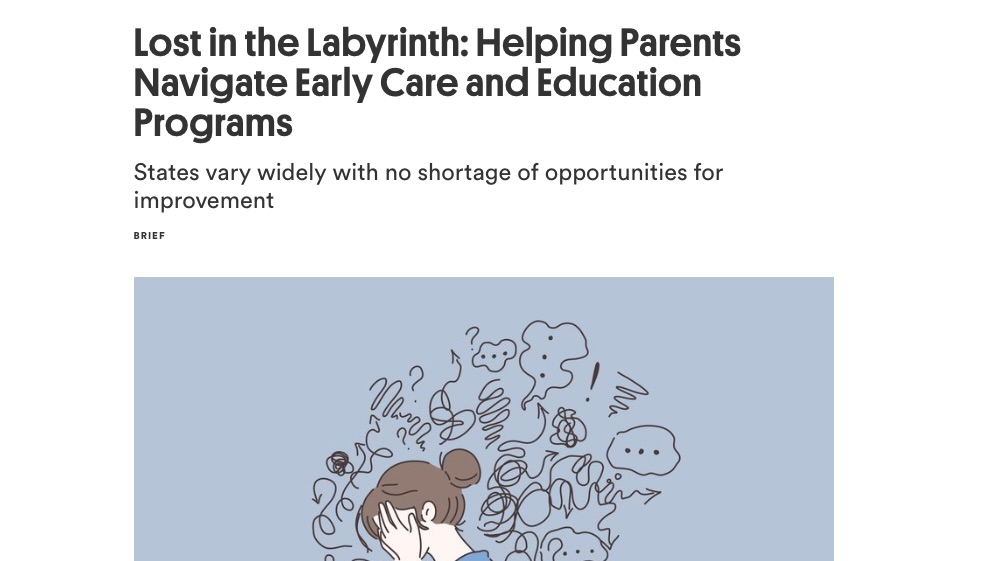
The Lost in the Labyrinth brief examines how fragmented early care and education (ECE) programs across the U.S. create challenges for families seeking services for young children.
The Summer EBT Playbook offers states practical strategies, tools, and examples to effectively implement the new Summer EBT program, ensuring low-income children receive food benefits when school is out.