Building on our February 2022 report Benefit Eligibility Rules as Code: Reducing the Gap Between Policy and Service Delivery for the Safety Net, the Beeck Center’s Digital Benefits Network (DBN) recently held a convening to share progress and potential in digitizing benefits eligibility and to begin addressing how a national approach could be started.
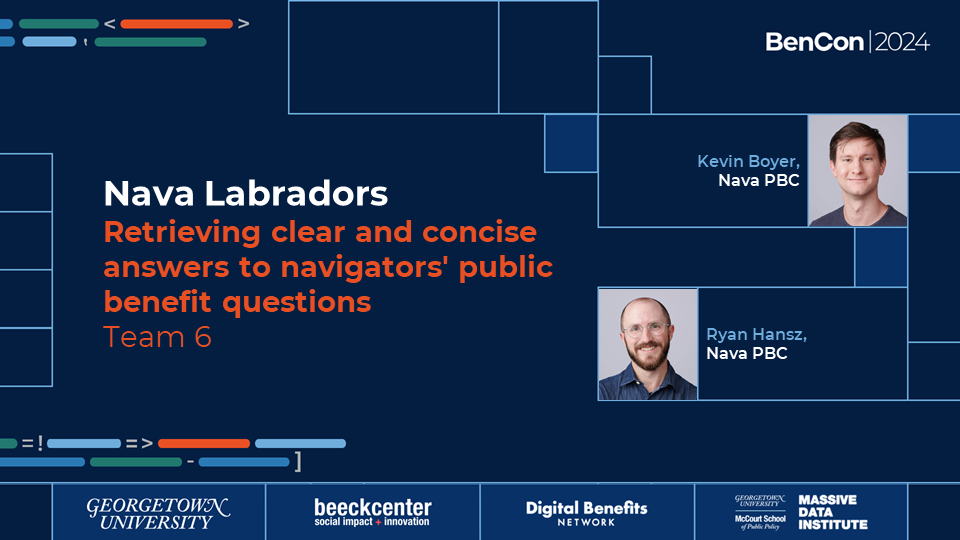
The team developed an AI solution to assist benefit navigators with in-the-moment program information, finding that while LLMs are useful for summarizing and interpreting text, they are not ideal for implementing strict formulas like benefit calculations, but can accelerate the eligibility process by leveraging their strengths in general tasks.
The Policy2Code Prototyping Challenge explored utilizing generative AI technology to translate U.S. government policies for public benefits into plain language and code, culminating in a Demo Day where twelve teams showcased their projects for feedback and evaluation.
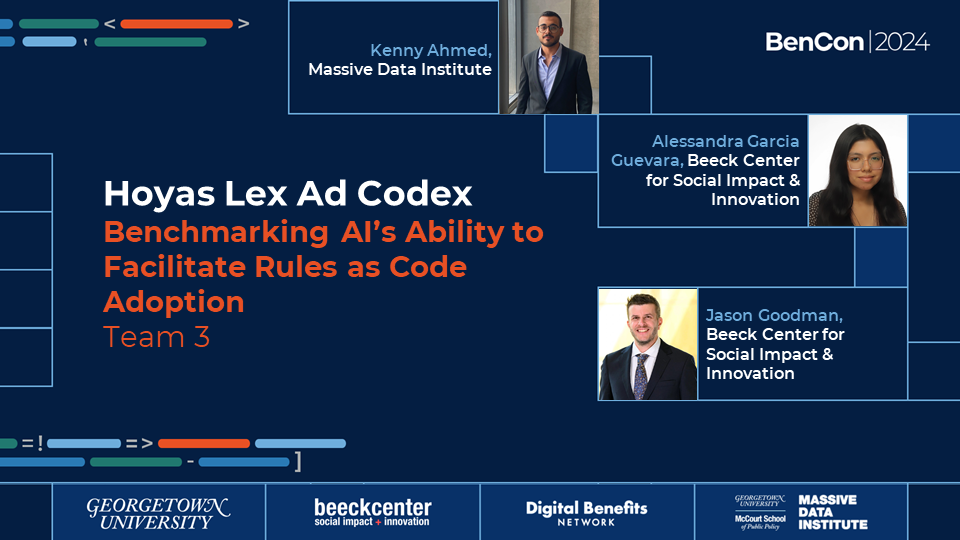
The team explored the performance of various AI chatbots and LLMs in supporting the adoption of Rules as Code for SNAP and Medicaid policies using policy data from Georgia and Oklahoma.
The team developed an application to simplify Medicaid and CHIP applications through LLM APIs while addressing limitations such as hallucinations and outdated information by implementing a selective input process for clean and current data.
The first half of Rules as Code Demo Day was wrapped up with Thomas Guillet who has contributed to Open Fisca France and beta.gouv. He demoed the code for Mes Aides—or My Benefits—which is France’s social benefit simulator that leverages open source rule models for over 600 benefits while keeping the displayed complexity to its minimum.
We continued Rules as Code Demo Day with Daniel Singer and Preston Cabe from Benefits Data Trust. Benefits Data Trust provides benefit outreach and application assistance services in seven states. Using Benefits Launch, their in-house interview and rules engine, they support two hundred contact center employees as they screen and apply thousands of clients each year. They also offer a self-service screener, Benefits Launch Express. Additionally, they offer an eligibility API to integrate with other services.
The team introduced "Policy Pulse," a tool to help policy analysts understand laws and regulations better by comparing current policies with their original goals to identify implementation issues.
The team introduced an AI assistant for benefits navigators to streamline the process and improve outcomes by quickly assessing client eligibility for benefits programs.
The team developed an AI-powered explanation feature that effectively translates complex, multi-program policy calculations into clear and accessible explanations, enabling users to explore "what-if" scenarios and understand key factors influencing benefit amounts and eligibility thresholds.
The team explored using LLMs to interpret the Program Operations Manual System (POMS) into plain language logic models and flowcharts as educational resources for SSI and SSDI eligibility, benchmarking LLMs in RAG methods for reliability in answering queries and providing useful instructions to users.
We wrapped up Rules as Code Demo Day with Max Ghenis and Nikhil Woodruff, the founders of PolicyEngine. The PolicyEngine web app computes the impact of tax and benefit policy in the US and the UK. With PolicyEngine, anyone can freely calculate their taxes and benefits under current law and customizable policy reforms, and also estimate the society-wide impacts of those reforms. Policymakers and think tanks from across the political spectrum can analyze actual policy. PolicyEngine is built atop the open source OpenFisca US and UK microsimulation models and they are building an open unified data set utilizing data from the Policy Rules Database, Current Population Survey, Survey of Consumer Finances, Consumer Expenditures, tax records, and IRS Public Use File.