“Where People Stumble”: Plain Language and Accessibility
This is the second story in a series about how digital government accessibility — or the lack thereof— shows up in everyday life.
Where People Stumble
A former bike mechanic who once questioned his own voting ballot now designs accessible content, so others don’t walk away unsure.

A11y Means all
This is the second story in a series about how digital government accessibility — or the lack thereof— shows up in everyday life, viewed through the lens of the Department of Justice’s Title II accessibility ruling.
Requirement 2
State and local governments’ web content usually needs to meet Web Content Accessibility Guidelines (WCAG) 2.1, Level AA.
Fluorescent lights cast a steady glow in the bike shop in Irvine, California, where rows of clean, orderly frames lined the walls, awaiting their riders.
For 14 years, Sean Isamu Johnson lived by the gospel of building wheels by hand, coaxing perfect tension into thin silver spokes. He learned early the stakes of small details that could break large systems — and the invisible work required to keep them whole. On a bike, if the balance is off, the wheel wobbles. If a bolt is stripped, the rider falls. He was the architect of someone else’s safety.
At 38, Johnson still rides. He carries the muscle memory of those early days: the trembling grip on the handlebars, the wobbly uncertainty of steering, and the fear of falling while the world watched. That vulnerability followed him years later as a mobility aide at the University of California, Los Angeles, where he helped a blind student navigate the painstaking maze of online class registration. He knew the challenges personally.
“No one wants to feel insecure [or] embarrassed,” he said. “I’ve felt insecure my entire life.”
In 2006, standing over his first voting ballot at Oak Creek Elementary, the 18-year-old Johnson felt like he was taking a test he hadn’t studied for.
“I still wasn’t confident that I did it right,” he remembered. “Did I break the law? Did I do everything correctly?”
For a long time, Johnson blamed himself and feared he had missed something obvious.
There were moments he thought: This is so stupid. I’m just not gonna do it. Maybe I won’t bother anymore.
Even later, after he had completed a forensic linguistics master’s degree, he wrestled with confusing election forms and opaque tax documents.
It took years for that feeling to change.
“It’s not really a problem with me,“ he realized. “It’s how these things [products and services] are presented. …Everyone understands things differently.”
Johnson eventually traded his spoke wrench for the tags, labels, and the structural hierarchy of the digital world. Today, as a designer-researcher, he acts as the invisible hand that sustains a democracy. He ensures mail voting materials, digital PDFs, and web content work for those relying on screen readers.
He is an evangelist for plain language, obsessed with the labels and instructions that allow a person to understand at first try. He knows that if information in a form is not tagged correctly or fields are mislabeled, a screen reader will skip it. If a sentence is too dense, a voter will hesitate — and a vote could be lost.
His work mirrors his past. To this day, Johnson still remembers the bike shop and building an adaptive bike for a one-armed man. Alongside his mentor, Johnson rewired the controls so a single hand could brake and shift at the same time. It was about providing “the same joy that everyone else has riding bikes,” he said.
For Johnson, success is the absence of the “wobble.” It is the moment a voter — the one with a disability, the one over 65, or the one for whom English is a second or third language — reaches the end of a ballot and knows, with absolute certainty, that their intent was captured. It is making sure they did not accidentally say “no” when they meant “yes.”
Today, he is still building wheels. He is just making sure the whole world gets to ride.
Explore digital accessibility resources
Accessibility
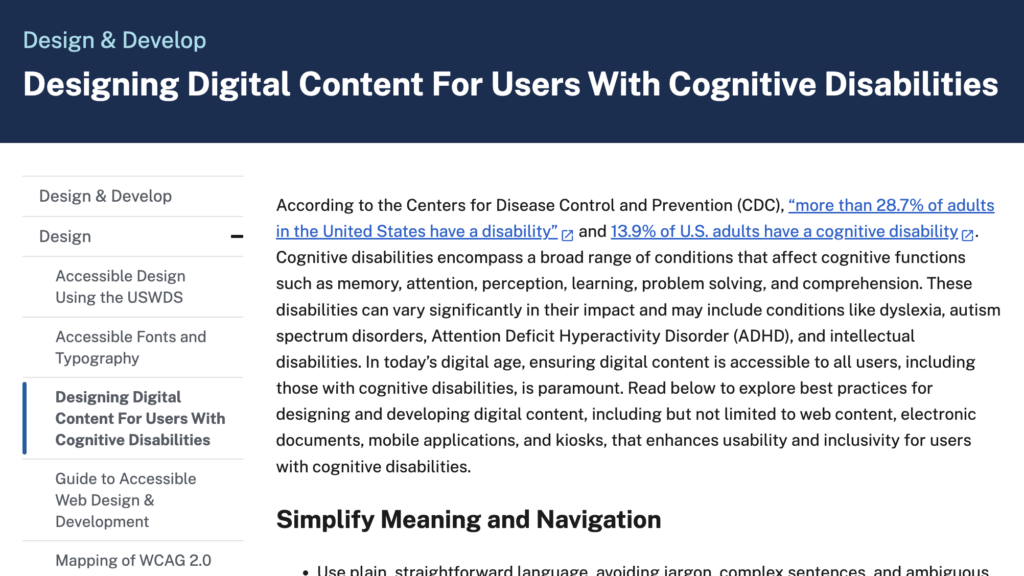
From Principle to Practice Accessibility is a critical practice in the process of designing government products and services as they are intended to be used by the general public. There are a number of potential accessibility components that need to be evaluated in this process to ensure that everyone can meaningfully access the digital experiences. […]
“You Didn’t Understand What They Meant”: The Hidden Barrier of Cognitive Accessibility
The first edition of this storytelling series explores the critical role of cognitive accessibility in digital government services through the personal experiences of a scholar and a mother navigating a complex bureaucracy.
What the DOJ Accessibility Deadline Really Means for Your Agency
The A11y Jam opening session that introduces the April 2026 DOJ digital accessibility requirements and provides practical, plain-language guidance for government teams preparing for compliance.