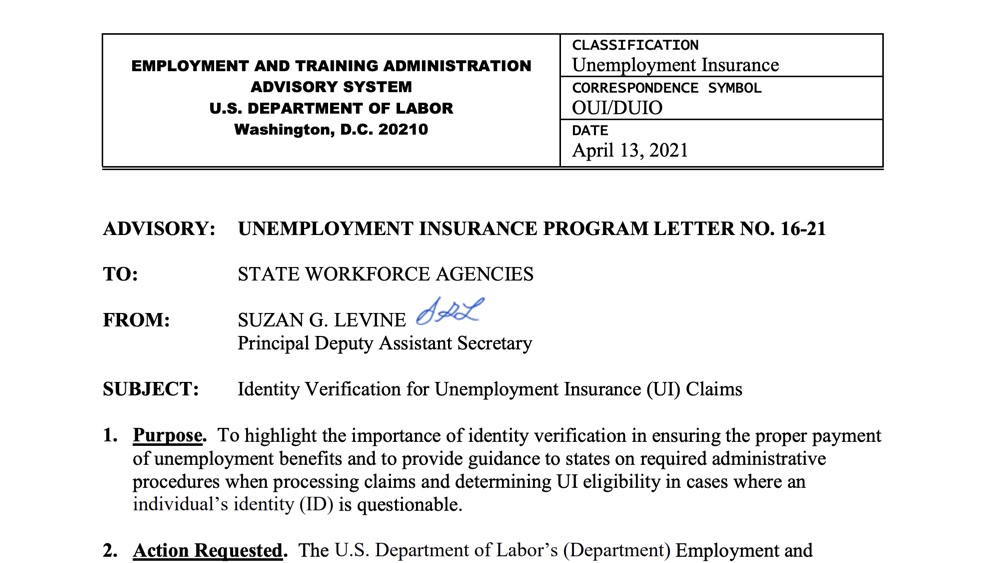
This program letter from the Employment and Training Administration Advisory System, U.S. Department of Labor to State Workforce Agencies highlights the importance of identity verification in ensuring the proper payment of unemployment benefits and provide guidance to states on required administrative procedures.
Employment and Training Administration Advisory System
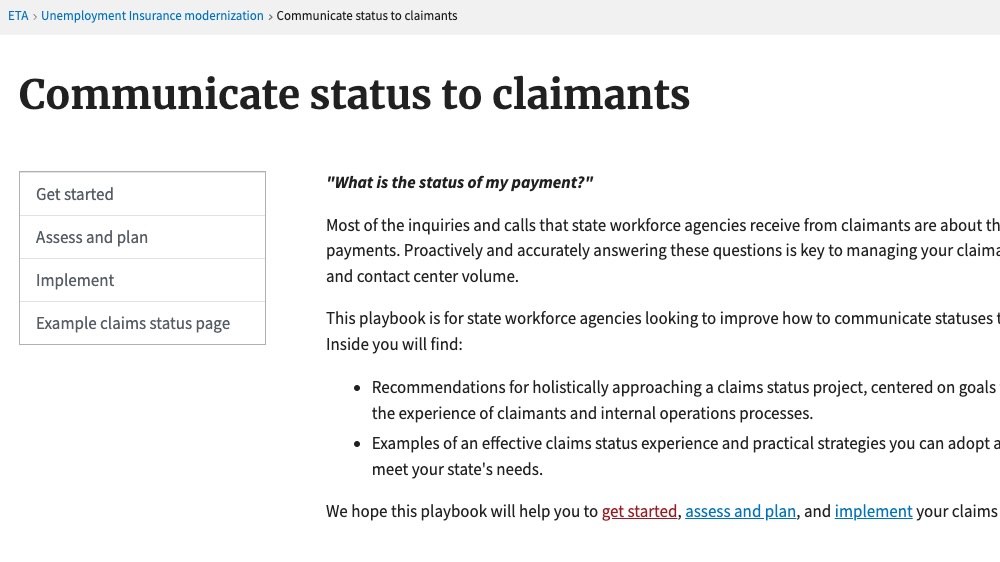
The U.S. Department of Labor provides a playbook to help state workforce agencies enhance communication with unemployment claimants by offering clear, proactive updates on claim statuses, thereby improving claimant satisfaction and reducing call center inquiries.
Government solicitations to procure custom software are often long, complicated, and take months. By using 18F’s agile contract format, agencies can hire an agile software contractor with a quickly-written dozen-page solicitation, allowing for immense savings in time and money.
Initially created to inform federal staff at the U.S. Department of Health and Human Services, this tip sheet provides key considerations for how organizations can identify potential diverse external partners, conduct outreach to them, and build and sustain productive relationships with them.
Office of the Assistant Secretary for Planning and Evaluation (ASPE)
Starting November 1, 2023, the Centers for Medicare & Medicaid Service (CMS) began asking three new optional sexual orientation and gender identity (SOGI) questions on the single, streamlined application developed by the Secretary. This guidance gives instructs states on the process for modifying SOGI questions in their applications.
Originally created for use by federal staff at the U.S. Department of Health and Human Services, this tool describes the six steps for conducting equity assessments and provides tips for completing each step.
Office of the Assistant Secretary for Planning and Evaluation (ASPE)
18F describes modular contracting, the process of breaking up large, custom software procurements into a small constellation of smaller contracts. Modular procurement requires agile, product thinking, user-centered design, DevSecOps, and loosely-coupled architecture.
This guide explains the U.S. Digital Service’s “discovery sprint,” a process by which teams can quickly build a common understanding of the status of complex organization, system, or service.
This playbook provides federal agencies with guidance on implementing AI in a way that is ethical, transparent, and aligned with public trust principles.
U.S. Department of Health and Human Services (HHS)