This playbook outlines the ways Community Action and human services agencies worked together to meet the pandemic challenge—what worked well, obstacles and difficulties, and lessons learned to inform the path forward, partnering to achieve a more equitable recovery. It also explains how communities have leveraged opportunities to partner on approaches that hold the promise of deeper, longer lasting changes for families—work shaped by families’ wishes and strengths and designed to advance both family-level and systems-level change.
American Public Human Services Association (APHSA)
This report documents best practices and lessons learned from project streamlined data sharing between SNAP and WIC, enhancing cross-enrollment processes
American Public Human Services Association (APHSA)
In this brief, APHSA outlines its commitment to addressing the causes of structural inequities by first illuminating structural root causes of race inequity within the context of human services. The brief outlines approaches to doing the intentional and systematic work that is required to counteract the structural barriers human services systems have fostered.
American Public Human Services Association (APHSA)
This brief provides a summary of potential federal funding sources and programs that can be used to support programs specifically targeted towards young families. While this list is not exhaustive, it highlights major sources that can serve as a starting point for braiding and blending of funding to create comprehensive programming to serve young families.
American Public Human Services Association (APHSA)
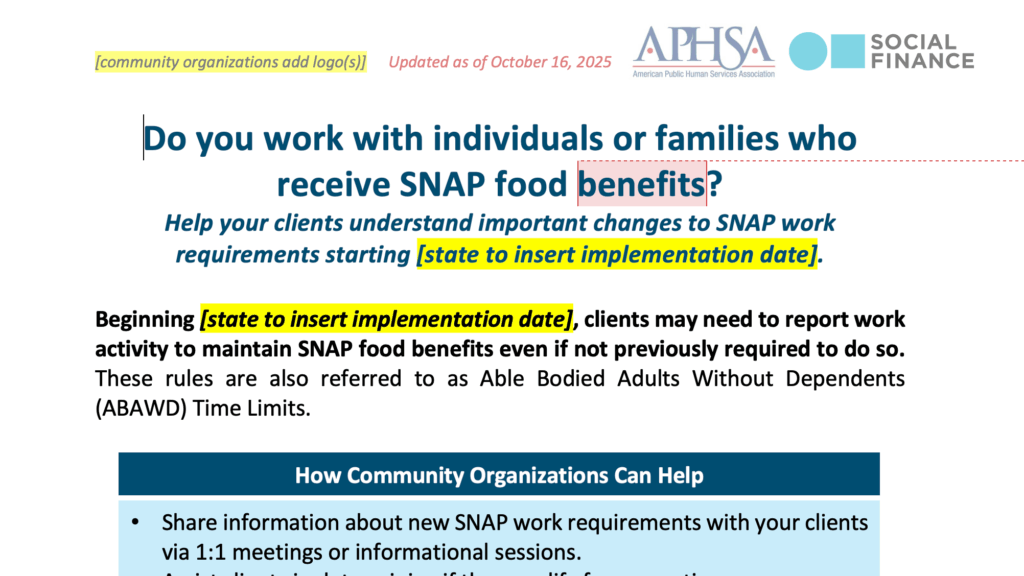
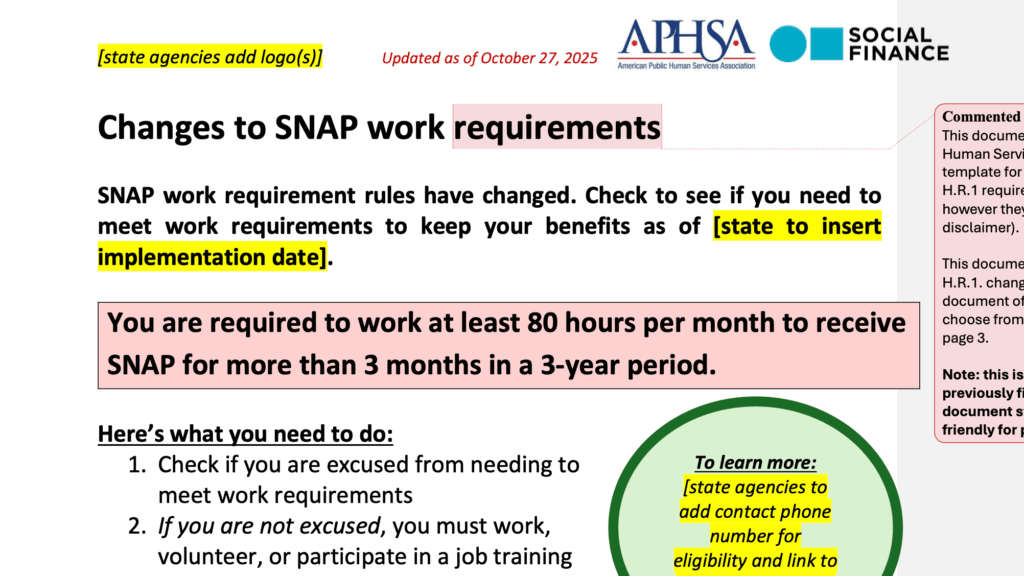
This document is a template for creating a community-based organization (CBO)-facing flyer that explains HR1 work requirements changes and how CBOs can help spread the work and screen SNAP participants and applicants.
American Public Human Services Association (APHSA)
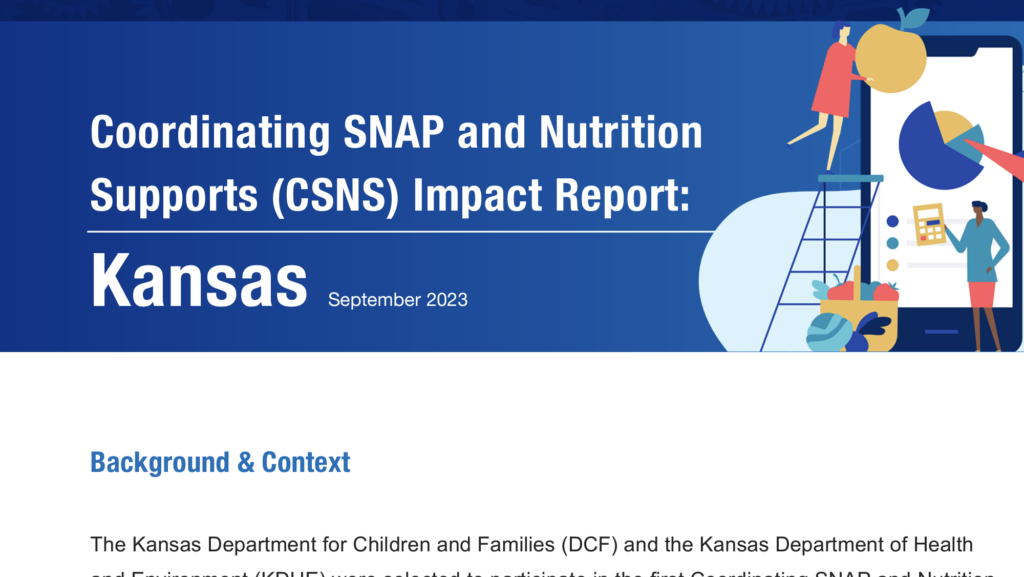
This report highlights best practices and lessons learned from Kansas' partnership with Delivering Change to improve SNAP and WIC access in seven counties through innovative data sharing and targeted outreach.
American Public Human Services Association (APHSA)
This brief synthesizes the manner in which the political and social service environments affect the intergenerational stability of non-citizen families, offering insights into programmatic supports.
American Public Human Services Association (APHSA)
A case study on how North Carolina leveraged human-centered design, interagency collaboration, and data-sharing strategies to improve cross-enrollment in SNAP, WIC, and Medicaid, aiming to reduce administrative burden and better serve families.
American Public Human Services Association (APHSA)
The COVID Response Project was funded by the W.K. Kellogg Foundation to document the real-time impacts of the COVID-19 pandemic on state human services agencies and capture state perspectives on lessons learned to guide future federal policymaking and state implementation. The project was completed by the American Public Human Services Association (APHSA) in partnership with the U.S. Department of Health and Human Services, Administration for Children and Families (ACF), Office of Regional Operations. Insights from the report reflect information obtained through APHSA’s on-going support of state human services agencies’ COVID-19 response efforts as well as a series of in-depth interviews with executive leadership of the 14 state health and human services agencies in ACF’s Region 1 (New England) and Region 4 (Southeast) areas.
American Public Human Services Association (APHSA)