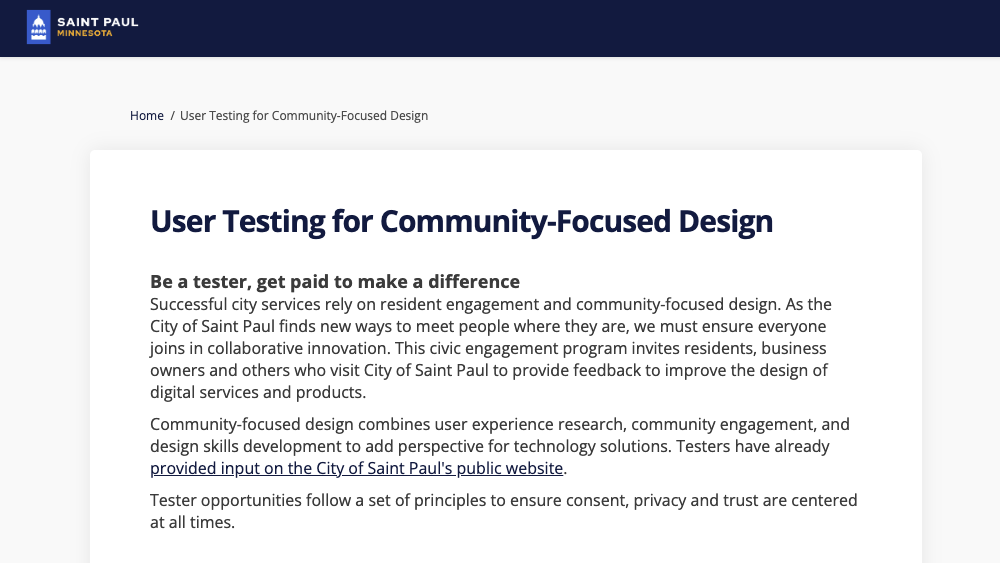
City of Saint Paul's website for community members to sign up to participate in paid research opportunities in order to test and provide feedback on the design of digital services and products.
The Digital Service Network (DSN) spoke with Ashley O’Brien, user experience designer for the City of Saint Paul, MN, about the flexible and resourceful approach she took to reach people across the city.
In June 2020, the state implemented an innovative and entirely virtual vendor selection process to evaluate these solutions under the direction of the Colorado Digital Service (CDS).
Presentation covering the findings of a research study analyzing the structural and budgetary layout of of eleven US-based Digital Service Teams (DSTs) at the municipal, county, and state levels.
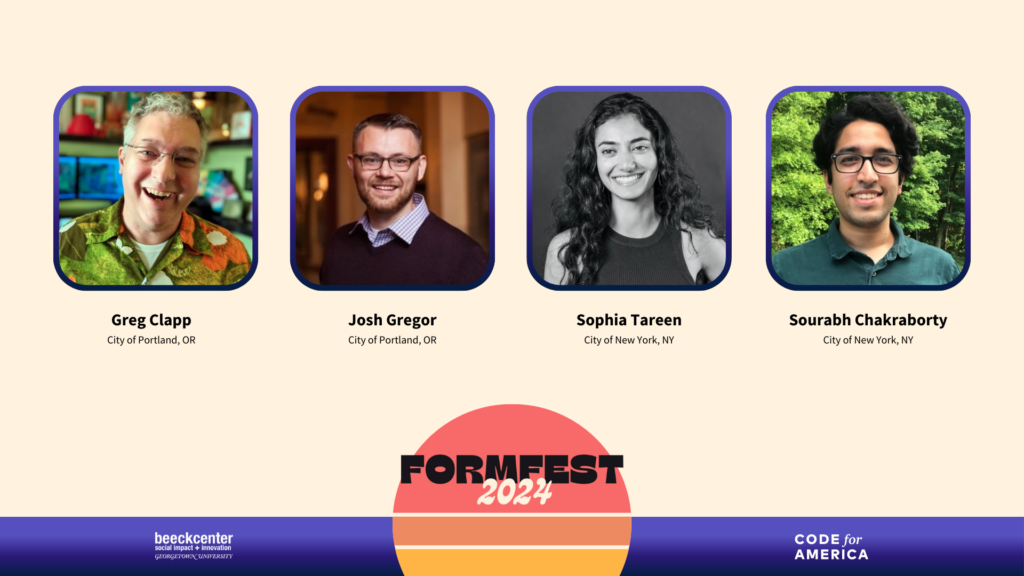
A profile on FormFest speakers Greg Clapp, Josh Gregor, Sophia Tareen, Sourabh Chakraborty, featuring stories about their motivations for working on public sector form innovation.
The article presents the True Cost of Economic Security (TCES) measure, showing that over half of U.S. families struggle to meet the comprehensive costs required to thrive, highlighting significant disparities based on family type, location, and race.
This resource introduces the "Layer Cake" approach, a framework for driving behavior change in government systems and public services by addressing all layers of service delivery, from frontline staff to policymakers, with an emphasis on human-centered design and civic participation.
This brief outlines research recommendations to better understand and improve income support and employment services for low-income and at-risk LGBT populations.
U.S. Department of Health and Human Services (HHS)
Key functionalities and design elements recommended for creating effective online WIC applications, focusing on usability, accessibility, and compliance to improve participant experience and streamline agency operations.