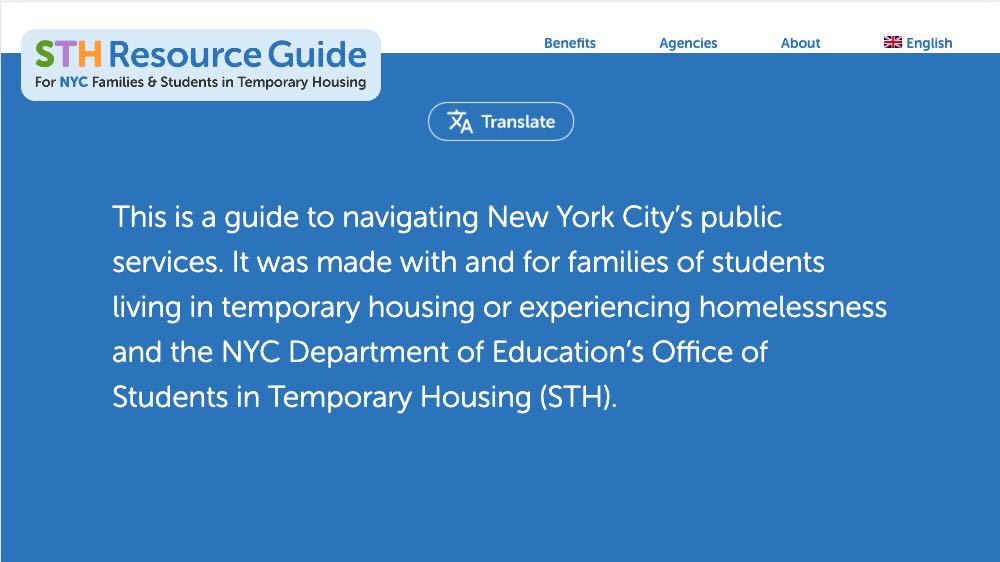
A guide to navigating New York City’s public services. It was made with and for families of students living in temporary housing or experiencing homelessness and the NYC Department of Education’s Office of Students in Temporary Housing (STH).
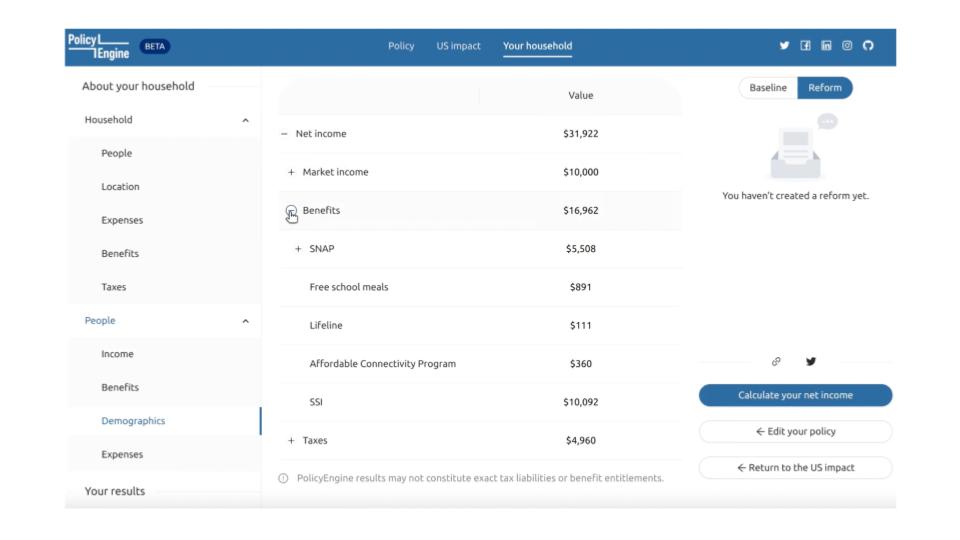
PolicyEngine is a nonprofit that provides a free, open-source web app enabling users in the US and UK to estimate taxes and benefits at the household level, while also simulating the effects of policy changes. By combining tax and benefits data, PolicyEngine helps individuals and policymakers better understand the impacts of existing policies and proposed reforms, using microsimulation models built from legislation and enhanced survey data.
APHSA established a working group to identify strengths, barriers, and opportunities for better system alignment in human services for young parents and children, leading to the development of a roadmap to support meaningful systems-level changes.
American Public Human Services Association (APHSA)
Code for America partnered with the CBPP, Civilla, and Nava to launch the Integrated Benefits Initiative, testing and piloting human-centered approaches to improve outcomes and learn what an optimal safety net could look like. This article describes key takeaways from short-term pilots implemented as part of this project.
Study by the Director of the Office of Management and Budget assessing methods for determining whether agency policies and actions create or exacerbate barriers to full and equal participation by eligible individuals. This study followed the Executive Order on racial equity.
This playbook provides federal agencies with guidance on implementing AI in a way that is ethical, transparent, and aligned with public trust principles.
U.S. Department of Health and Human Services (HHS)
Hennepin County, Minnesota, implemented an online application system for child care assistance, resulting in increased applications, faster benefit distribution, and reduced administrative burdens.
The report examines pilot projects in multiple states that utilized data matching and targeted outreach to enroll eligible families with young children in the WIC program, demonstrating the effectiveness of this approach in increasing participation rates.