This brief provides research recommendations to improve programs serving LGBT youth, focusing on homelessness and sexual health education services funded by the U.S. Department of Health and Human Services.
U.S. Department of Health and Human Services (HHS)
This foundational article develops the concept of administrative burden, defining it as the learning, psychological, and compliance costs individuals face when interacting with government, and argues that these burdens are often shaped by political choices.
Journal of Public Administration Research and Theory
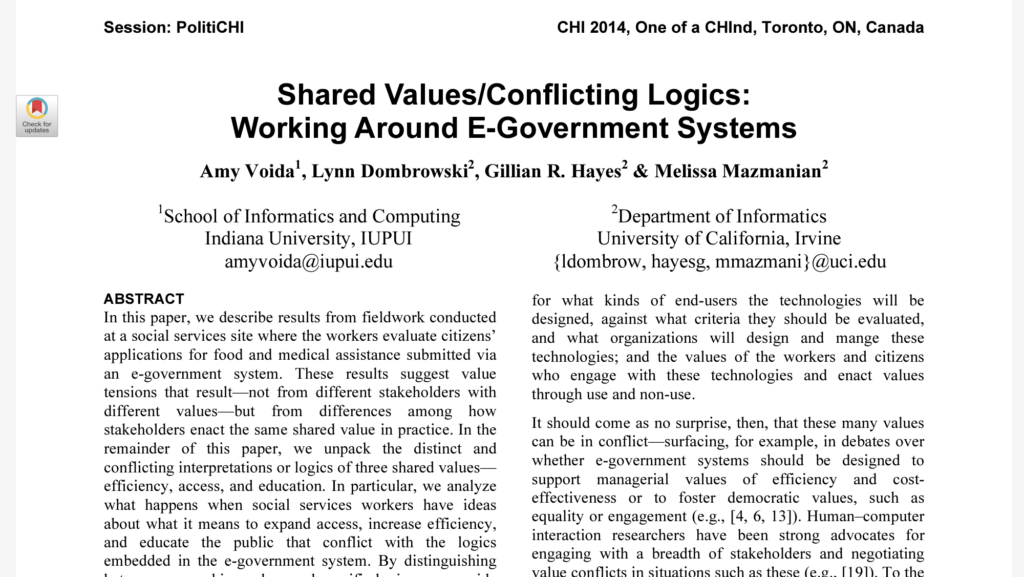
This paper describes results from fieldwork conducted at a social services site where the workers evaluate citizens' applications for food and medical assistance submitted via an e-government system. These results suggest value tensions that result - not from different stakeholders with different values - but from differences among how stakeholders enact the same shared value in practice.
CHI '14: Proceedings of the SIGCHI Conference on Human Factors in Computing Systems
This paper examines three key questions in participatory HCI: who initiates, directs, and benefits from user participation; in what forms it occurs; and how control is shared with users, while addressing conceptual, ethical, and pragmatic challenges, and suggesting future research directions.
This paper analyzes the unique challenges of conducting participatory design in large-scale public projects, focusing on stakeholder management, fostering engagement, and integrating participatory methods into institutional transformation.
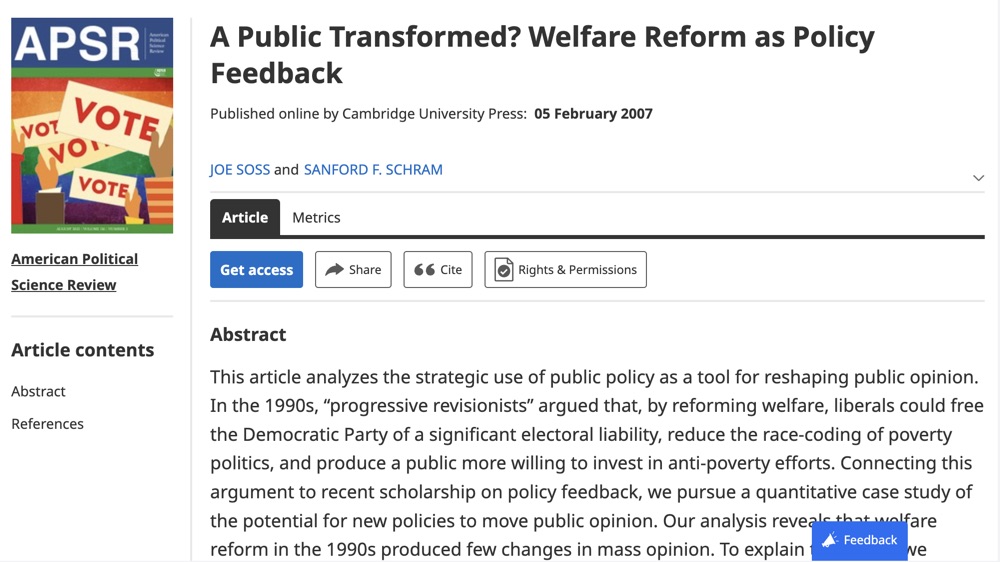
This article analyzes the strategic use of public policy as a tool for reshaping public opinion. Though progressive revisionists in the 1990s argued that reforming welfare could produce a public more willing to invest in anti-poverty efforts, welfare reform in the 1990s did little to shift public opinion. This study investigates the general conditions under which mass feedback effects should be viewed as more or less likely.
A growing observatory of examples of how open data from official sources and generative artificial intelligence (AI) are intersecting across domains and geographies.
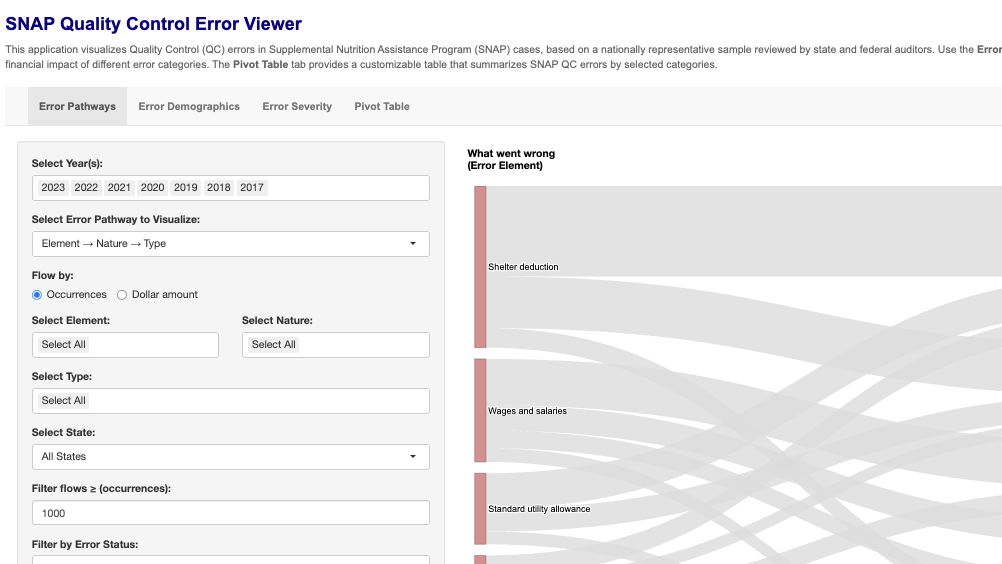
An interactive dashboard that enables users to explore and monitor key metrics of the Supplemental Nutrition Assistance Program (SNAP) Quality Control (QC) system.